


If you’ve spent any time scrolling through Instagram Stories, Snapchat, or TikTok comments in 2026, chances are you’ve bumped into the letters “SFS” and wondered what on earth they meant. Maybe a friend sent you a DM asking “wanna do sfs?” or you saw it tagged under a post with a string of usernames. Either way, you’re not alone in scratching your head.
SFS is one of those social media acronyms that looks confusing at first but turns out to be pretty simple once you understand the context. This guide breaks down exactly what SFS means in text, where it’s used, how it differs across platforms and genders, and whether it’s actually worth doing in 2026.
What Does SFS Mean in Text?
In most texting and social media conversations, SFS stands for “Shoutout for Shoutout.” It’s a mutual promotion agreement between two users, where each person posts about the other’s account — usually through a Story, post, or mention — in exchange for the same favor in return.
Think of it as a digital handshake: “I’ll promote you, you promote me, and we both gain some visibility.”
That said, SFS isn’t a one-size-fits-all acronym. Depending on the platform or the tone of the conversation, it can also mean:
- Snap for Snap — common on Snapchat, where users exchange snaps to build streaks or visibility
- Spam for Spam — asking someone to like or comment repeatedly on your posts
- So Freaking Sweet / So Frustratingly Stupid — occasionally used as a reaction phrase, though far less common than the shoutout meaning
- Follow-related slang — sometimes loosely mixed up with follow-for-follow culture
Context is everything. If someone sends “sfs” right after talking about their Instagram or asking for your username, they almost certainly mean shoutout for shoutout. If it shows up in a totally unrelated sentence, it might be a mood-based abbreviation instead.
Where Is SFS Commonly Used?
SFS shows up across nearly every major social platform, but it carries slightly different weight depending on where you see it.
| Platform | Common SFS Meaning | Typical Format |
| Shoutout for Shoutout | Story repost, tagged post, or caption | |
| Snapchat | Snap for Snap / Shoutout for Shoutout | Snap story or chat message |
| TikTok | Shoutout for Shoutout | Comment or duet caption |
| Twitter/X | Shoutout for Shoutout (less common) | Reply or quote post |
| Text/DMs | Shoutout for Shoutout or a general acronym | Casual chat message |
It’s most popular among creators, small businesses, and everyday users who are trying to grow their following organically without paying for ads or promotions.
What Is SFS in Instagram?
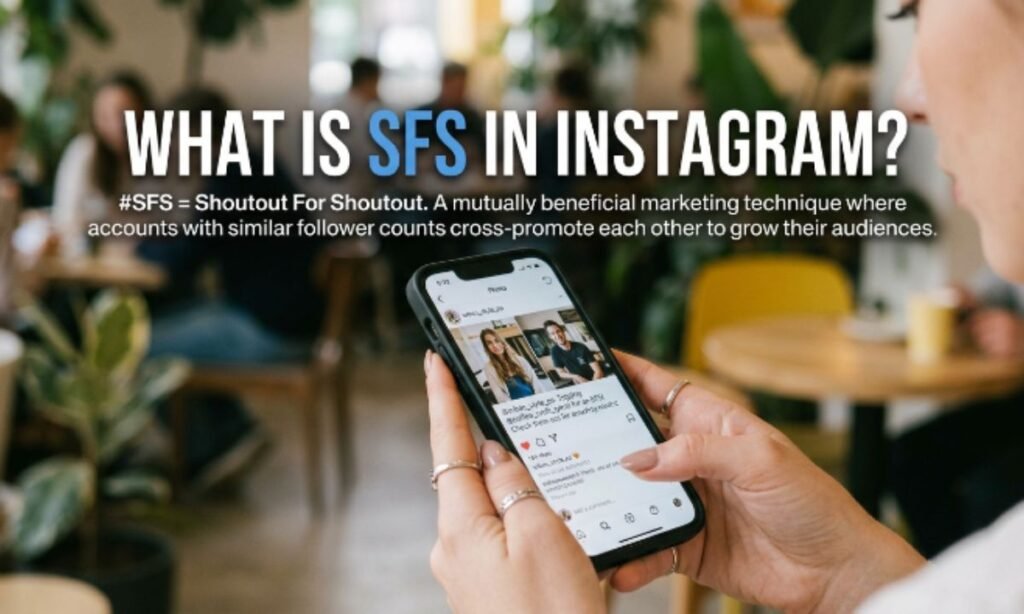
Instagram is really where SFS lives and breathes. Because the platform is so visual and story-driven, SFS is a natural fit — it’s easy to repost someone’s photo or tag their profile in your Story for a few hours.
On Instagram, an SFS typically works like this:
- Two users (often with similar follower counts or niches) agree to promote each other.
- Each person posts a Story, feed post, or caption tagging the other’s account.
- Both accounts get exposed to a new audience, ideally leading to new followers or engagement.
You’ll often see captions like “SFS with @username” or “Doing SFS today, comment your handle below!” This is especially common among smaller influencers, meme pages, art accounts, and niche communities like gaming, fashion, or fitness pages looking to expand their reach.
It’s worth noting: Instagram doesn’t have an official “SFS” feature or button. It’s purely community slang — an informal agreement between users, not something built into the app itself.
Examples of SFS in Conversation
Seeing SFS used in real conversations makes the meaning click much faster. Here are a few common examples:
Example 1 — Instagram DM
Person 1: “Hey! Love your page. Want to do an SFS?”
Person 2: “Sure, send me your @ and I’ll post it tonight.”
Example 2 — Snapchat Story caption
“SFS 🔥 comment your username if you want a shoutout back!”
Example 3 — TikTok comment
“Doing SFS for anyone under 5k followers, drop your handle 👇”
Example 4 — Casual text between friends
Chris: “Thanks for the SFS!”
Ryan: “Anytime, hope it brings you some new followers 😄”
In every case, the meaning stays consistent: two people agreeing to mutually promote each other’s accounts.
When to Use and When Not to Use SFS

SFS can genuinely help you connect with new people and grow your presence — but only when it’s used thoughtfully. Here’s a quick breakdown.
When to Use SFS
- When you want to network with accounts in a similar niche (fitness, art, gaming, fashion, etc.)
- When you and the other account have roughly similar follower counts, so the exchange feels fair
- When you’re a small creator or business trying to grow organically without paid ads
- When you genuinely like the other person’s content and want to support them
When Not to Use SFS
- In professional or formal settings — sending “sfs” in a work email or client message will just come off as confusing
- When you’re cold-messaging strangers repeatedly, which can come across as spammy
- When the other account is wildly bigger or smaller than yours, making the exchange one-sided
- When you’re only chasing numbers rather than building a real audience — SFS shoutouts from irrelevant accounts rarely bring engaged followers
What Does SFS Mean in Text From a Guy?
The meaning of SFS doesn’t actually change based on who’s sending it — it’s still most likely “Shoutout for Shoutout.” However, tone can shift things a little. If a guy sends “sfs?” out of nowhere in a flirty or casual DM conversation, he may be using it as an icebreaker to connect on Instagram or Snapchat rather than a purely business-style exchange.
In short: the acronym stays the same, but pay attention to the surrounding conversation to figure out whether it’s a genuine social media collab or just a way to keep the chat going.
What Does SFS Mean From a Girl?
Same logic applies here. When a girl uses SFS in text, it almost always still means Shoutout for Shoutout. It’s not inherently flirty or romantic — it’s a transactional, promotion-based term regardless of gender.
If it feels like it’s being used to build a connection rather than grow a following, that’s more about the context of your conversation than a hidden meaning behind the acronym itself.
What Does SFS Mean in Text in Urdu?
For Urdu-speaking social media users, SFS carries the exact same meaning as it does in English: “Shoutout for Shoutout” (شاؤٹ آؤٹ کے بدلے شاؤٹ آؤٹ). It’s commonly used the same way across Pakistani and South Asian Instagram, Snapchat, and TikTok communities — as a mutual account-promotion arrangement between two users. The acronym itself isn’t translated; it’s used as-is, the same way many English internet slang terms are borrowed directly into everyday Urdu texting.
Similar Slang Words or Alternatives
SFS isn’t the only acronym floating around for account promotion and social growth. Here are a few related terms you might come across:
| Acronym | Meaning |
| S4S | Shoutout for Shoutout (alternate spelling) |
| F4F | Follow for Follow |
| L4L | Like for Like |
| C4C | Comment for Comment |
| DM4DM | Direct Message for Direct Message (collab discussions) |
| TFT | Thanks for the (Follow/Trade) |
These terms often circulate in the same communities, especially among creators trying to grow their audience through mutual support rather than algorithms alone.
SFS vs S4S: Is There a Difference?
Not really. SFS and S4S are essentially the same thing — both mean “Shoutout for Shoutout.” The only difference is stylistic: some users prefer spelling it out with letters (SFS), while others use the number “4” as a stand-in for “for” (S4S), similar to how F4F represents “Follow for Follow.”
You’ll see both used interchangeably across Instagram, Snapchat, and TikTok, so there’s no need to worry about picking the “right” one — they mean exactly the same thing.
How to Ask for an SFS the Right Way

If you want to try SFS to grow your account, doing it politely and strategically makes a big difference. Here’s a simple approach:
- Find accounts in your niche. Look for creators or businesses with content similar to yours — this ensures the audience overlap is relevant.
- Check their follower count. Try to match with accounts of a similar size so the exchange feels fair to both sides.
- Send a polite, direct message. Something like: “Hey! I really like your content — want to do an SFS today?”
- Agree on the details. Decide whether it’ll be a Story repost, tagged post, or caption mention, and when you’ll post it.
- Follow through. Post what you agreed to and let the other person know once it’s live.
- Say thanks. A simple “thanks for the SFS!” keeps the relationship friendly for future collabs.
Common Mistakes People Make With SFS
Even though SFS is simple in theory, plenty of people mess it up in practice. Watch out for these common pitfalls:
- Messaging way bigger accounts expecting an equal shoutout — this rarely works and can come off as pushy
- Not following through after agreeing to a shoutout, which damages trust
- Spamming multiple accounts at once with generic “sfs?” messages
- Ignoring niche relevance — promoting a beauty page to a gaming audience won’t bring meaningful followers
- Using SFS in professional communication, where it just causes confusion
- Expecting huge growth from one exchange instead of treating it as a small, steady networking tool
Does SFS Actually Help Grow an Account?
SFS can offer a short-term boost in visibility, especially if you’re a smaller account partnering with someone whose audience genuinely overlaps with yours. It’s free, quick, and can introduce your profile to people who might not have found you otherwise.
That said, SFS has its limits:
- Short-term spikes, not long-term growth. A shoutout might bring a handful of new followers, but it won’t replace consistent, quality content.
- Quality over quantity matters. A shoutout from a highly engaged, niche-relevant account is far more valuable than one from a random, unrelated page.
- Algorithms still favor content, not shoutouts. Platforms like Instagram and TikTok reward watch time, saves, and shares — SFS is just one small piece of a much bigger growth strategy.
In 2026, with algorithms leaning even more heavily on content relevance and engagement signals, SFS works best as a supplementary tactic — not a replacement for building an actual content strategy.
Conclusion
So, what does SFS mean in text? In nearly every case, it stands for “Shoutout for Shoutout” — a simple, mutual agreement where two users promote each other’s accounts to grow their reach. It’s most common on Instagram, Snapchat, and TikTok, and while its exact tone can shift slightly depending on who’s sending it or the platform it’s used on, the core meaning stays consistent across genders and languages.
Used thoughtfully — with relevant, similarly sized accounts and genuine follow-through — SFS can be a handy, free way to network and gain a little visibility. Just don’t expect it to replace real content strategy or organic growth. Used carelessly, it can come across as spammy or ineffective.
Now that you know exactly what SFS means and how to use it the right way, you’ll never be confused the next time someone slides into your DMs asking, “wanna do an sfs?”
Frequently Asked Questions
What does SFS mean in text?
SFS most commonly means “Shoutout for Shoutout,” a mutual promotion agreement between two social media users.
What does SFS mean on Instagram specifically?
On Instagram, SFS refers to two accounts promoting each other, usually through a Story repost, tagged post, or caption mention.
Is SFS the same as S4S?
Yes, S4S is simply an alternate spelling of SFS, and both mean the exact same thing.
Does SFS always involve two similar-sized accounts?
Not always, but it works best when both accounts have a similar follower count, since it keeps the exchange fair for everyone involved.
Can SFS help grow my account?
Yes, but mainly for short-term visibility — it works best alongside consistent, high-quality content rather than as a standalone growth strategy.
Is SFS only used by influencers?
No, anyone can use SFS, including small creators, everyday users, and small businesses looking to boost their reach.
What is the difference between SFS and F4F?
SFS focuses on shoutouts and promotional posts, while F4F (Follow for Follow) is simply about mutually following each other’s accounts.
