
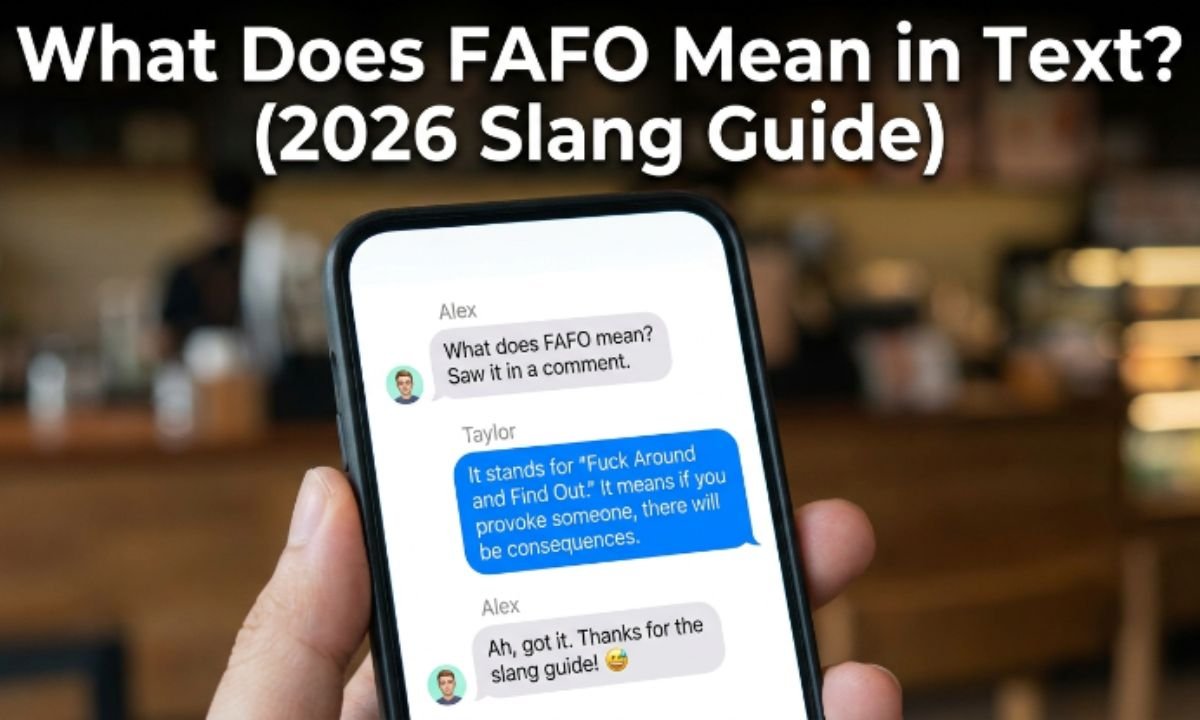

If you’ve scrolled through TikTok comments, Twitter/X replies, or even a group chat lately, chances are you’ve seen someone drop “FAFO” like a mic. Once buried in Urban Dictionary entries and biker forums, this four-letter acronym has exploded into mainstream vocabulary showing up in memes, political headlines, sports commentary, and casual texts between friends.
By 2026, FAFO isn’t just internet slang anymore. it has moved beyond internet culture into political press conferences, podcast titles, and everyday captions after a sports collapse, a rage-quit, or a market crash. If you’ve been left wondering what it actually means, how to use it, or whether it’s rude to say, this guide breaks it all down in plain English.
FAFO Meaning in Text
At its core, FAFO stands for “F* Around and Find Out.”** It’s a blunt, four-word warning packed into four letters, built on the idea that if someone pushes boundaries, tests limits, or ignores advice, they will eventually face the results of their own actions.
In texting, FAFO usually replaces an entire sentence. Instead of typing out “if you keep doing that, you’re going to regret it,” people just type three letters and let the tone of the conversation fill in the rest.
Some common ways FAFO shows up in text conversations:
- “Keep ignoring my texts… FAFO.”
- “He skipped studying all semester. FAFO’d on exam day.”
- “I know eating this whole pizza is a bad idea. FAFO.”
Notice that FAFO can point forward (a warning about what’s about to happen) or backward (a comment on what already happened). That flexibility is exactly why it has spread so fast it works as a threat, a joke, and a recap all at once.
Softer, Cleaner Versions of FAFO
Because the full phrase contains profanity, many platforms and publications write it differently to keep things PG:
- Fool Around and Find Out
- Eff Around and Find Out
- Figuring And Finding Out (a cleaned-up joke version some people use ironically)
These softer versions carry the same underlying meaning — actions have consequences — just without the swear word.
What Does FAFO Mean in Chat?
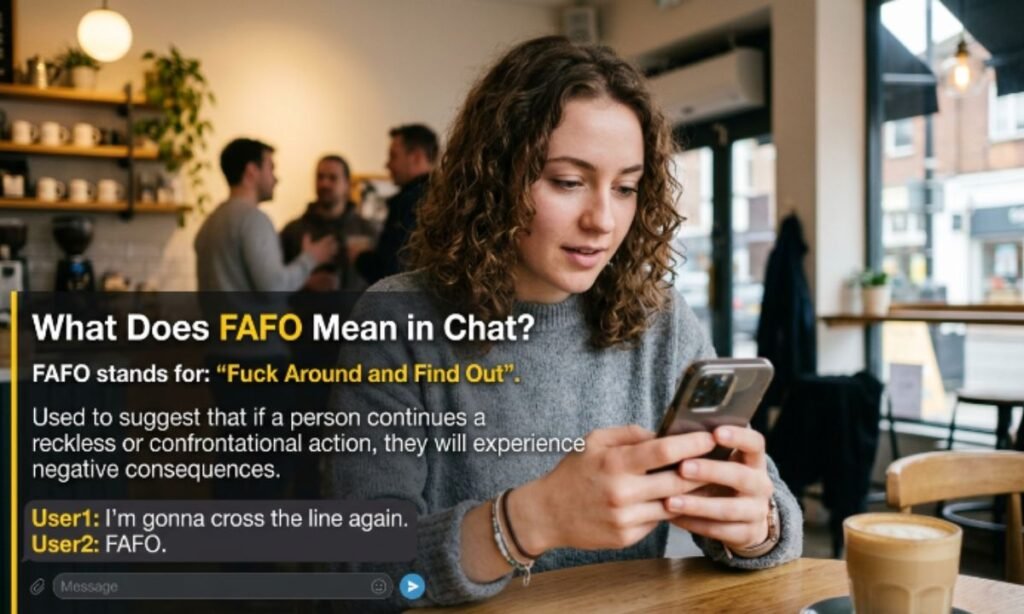
When someone drops “FAFO” mid-conversation, they’re typically reacting to one of these situations:
- Risky or reckless behavior
- A bold, over-confident statement
- Someone testing a boundary or limit
- A dramatic situation that’s clearly headed somewhere bad
Instead of spelling out a lecture, the sender just types the acronym. It’s short, direct, and lets the other person fill in the blank themselves which is part of what makes it feel so punchy in a chat thread.
Example chat exchange:
A: I’m going to text my ex at 2am, what could go wrong? B: FAFO. A: …you’re probably right.
Here, FAFO isn’t aggressive it’s more like a friendly heads-up wrapped in dry humor.
FAFO Slang Meaning Across Platforms
FAFO doesn’t mean exactly the same thing everywhere. The platform shapes the tone.
FAFO Meaning on TikTok
On TikTok, FAFO shows up constantly as a caption on “watch till the end” videos clips where someone does something reckless and the consequence lands seconds later. It’s often paired with dramatic music, slow-motion replays, or a laughing emoji, and the tone tends to be entertaining and a little sarcastic rather than genuinely angry.
FAFO Meaning on Twitter/X
On X, FAFO frequently appears in reply threads after a bold or careless post backfires. It’s commonly used to comment on public consequences a company facing backlash, a public figure getting called out, or a hot take that aged badly overnight.
FAFO Meaning on Reddit
Reddit threads use FAFO similarly, but often with more detail attached a full story followed by “and that’s how he FAFO’d” as the punchline. It works as both commentary and a mini-verdict on someone else’s poor decision-making.
FAFO in Group Chats and DMs
In personal messaging, FAFO tends to be more playful. Friends use it to tease each other about bad decisions skipping the gym, texting an ex, spending too much money without it necessarily being a genuine threat.
| Platform | Common Tone | Typical Use Case |
| TikTok | Entertaining, sarcastic | Captioning reckless behavior videos |
| Twitter/X | Blunt, sometimes political | Commenting on public backlash |
| Storytelling, punchline | Wrapping up a “the audacity” story | |
| Texting/DMs | Playful, teasing | Friendly warnings between friends |
| Political/News | Serious, provocative | Signaling consequences or defiance |
Tone & Context Variations
FAFO is one of those rare slang terms that can swing between friendly and hostile depending entirely on delivery. Here’s how the tone typically breaks down:
- Warning Tone
Used before something happens, as a direct caution: “Don’t test me. FAFO.”
- Sarcastic Tone
Used to gently mock someone’s bad choice:
A: I’m totally going to text my ex. B: FAFO. A: You’re right…
- Schadenfreude Tone (Post-Consequence)
Used after the fact, often with a hint of “I told you so”: “He ignored every warning sign and FAFO’d hard.”
- Self-Aware / Comedic Tone
Used on yourself, acknowledging you’re making a questionable choice anyway: “I’m eating the whole pizza tonight. FAFO.”
- Serious or Confrontational Tone
Used as a genuine threat or hard line, especially in arguments, sports rivalries, or political contexts, where it signals defiance rather than humor.
Grammar & Language Role

Unlike most texting acronyms, FAFO is unusually flexible grammatically. It can function as:
- A noun “That was a classic FAFO moment.”
- A verb “He FAFO’d and lost everything.”
- An adjective “That’s such a FAFO decision.”
- An interjection “FAFO!” (standalone reaction)
- A hashtag #FAFO, used to tag posts about instant karma or consequences
This grammatical range is part of why dictionaries have started tracking it seriously — it behaves like a real, evolving piece of vocabulary rather than a one-note meme phrase.
Read More:What Does POS Mean in Slang? Full Guide
How to Reply When Someone Says “FAFO”
If someone sends you “FAFO,” your reply depends on the tone of the conversation:
- If it’s playful: Reply with a laughing emoji, “lol true,” or “we’ll see.”
- If it’s a genuine warning: Acknowledge it “Fair point, I’ll be careful.”
- If it’s sarcastic teasing: Lean into the joke “I know, I know, don’t judge me.”
- If it feels hostile or aggressive: You can call it out directly, ask what they mean, or simply disengage if the conversation is escalating.
A good rule of thumb: match their energy. FAFO is rarely meant to be taken as a literal threat outside of genuinely tense situations, so read the room before reacting defensively.
Is FAFO Rude or Bad?
This depends heavily on context, but here’s the honest breakdown:
It can be rude when:
- Used aggressively toward someone in a real conflict
- Directed at someone during a sensitive or emotional moment
- Used to mock someone’s genuine mistake or hardship
It’s generally not rude when:
- Used jokingly between friends
- Used self-referentially (“I know this is a bad idea, FAFO”)
- Used as light commentary on a meme or viral clip
Because the phrase is built on profanity, some people find it inherently crude regardless of tone so it’s worth reading your audience before using it around parents, coworkers, or anyone who might not appreciate the underlying language.
FAFO Meaning for Trump
FAFO crossed fully into political territory when former President Donald Trump used it publicly. The phrase gained attention as a warning tied to a diplomatic dispute with Colombia, drawing comparisons to sayings like “if you mess with the bull, you get the horns”.
The moment escalated further later on. Trump posted an AI-generated image of himself wearing a black hat printed with “FAFO” on Truth Social, and the image spread rapidly among supporters and across social media. Around the same period, Defense Secretary Hegseth reportedly used the term FAFO when discussing a military operation, and the White House itself shared imagery using the phrase, effectively turning a piece of internet slang into a political messaging tool.
This crossover shows how far FAFO has traveled from casual online banter to official government-adjacent communication, illustrating just how mainstream the phrase has become.
Who Uses FAFO?
FAFO isn’t limited to one group. It’s used across a surprisingly wide range of communities:
- Gen Z and younger millennials casual texting, memes, reaction videos
- Parents describing “natural consequences” parenting, letting kids learn from their own mistakes
- Gamers reacting to reckless in-game decisions
- Sports fans commenting on teams or players who overhyped themselves and lost
- Political commentators describing consequences of policy decisions or provocative statements
- Crypto and finance communities reacting to risky trades or market crashes
- Military and tactical slang circles used informally as a tough, no-nonsense warning
FAFO Meaning in Memes and Viral Trends
Memes are where FAFO really thrives. The format is simple: show someone doing something reckless, then show the consequence, and caption it “FAFO.” It works because it’s instantly recognizable and requires zero extra explanation.
FAFO has also fueled some surprising internet moments:
- A viral meme coin briefly surged in value after being tied to Trump’s FAFO messaging
- Country and viral musicians have released songs simply titled “FAFO”
- Political cartoons and edited images regularly use the acronym as a punchline
The meme version of FAFO tends to be more humorous and exaggerated than the texting version it’s less about genuine warning and more about entertainment.
FAFO in 2026 Gen Z Slang Culture
Within Gen Z slang, FAFO fits into a broader family of blunt, consequence-driven phrases that reject sugar-coating. It sits alongside terms that emphasize accountability, karma, and “no cap” honesty reflecting a broader online culture that values directness over diplomacy.
What makes FAFO stand out from typical slang trends is its staying power. Most internet phrases fade within months, but FAFO has continued evolving moving from memes, into parenting language, into political discourse, and even into finance without losing its original meaning along the way.
Origin & Internet Culture
So where did FAFO actually come from?
Its roots trace back to African American Vernacular English (AAVE) and biker culture, where it gained early popularity before crossing over into mainstream internet slang. From there, it spread into broader biker communities, where early Urban Dictionary entries linked FAFO to warnings about underestimating dangerous people.
Over time, the phrase moved from niche subcultures into mainstream internet use, eventually reaching a level of recognition where major dictionaries started tracking it. Merriam-Webster added FAFO to its slang dictionary, and Urban Dictionary has carried multiple entries on the term for years. Merriam-Webster specifically defines it as an expression of warning or schadenfreude — capturing both the threat before consequences hit and the satisfaction of watching someone learn the hard way.
This kind of dictionary recognition is rare for internet slang, and it signals that FAFO has moved past “meme phase” into genuinely established vocabulary.
Comparison Table: FAFO vs. Similar Slang Terms
| Term | Meaning | Typical Tone | Common Usage Context |
| FAFO | Actions have consequences | Warning, sarcastic, or self-aware | Texting, memes, politics |
| IDK | “I don’t know” | Neutral, uncertain | General conversation |
| YOLO | “You only live once” | Encouraging risk-taking | Justifying a bold decision |
| WAGMI | “We’re all gonna make it” | Optimistic | Crypto and community hype |
| NGMI | “Not gonna make it” | Pessimistic, mocking | Crypto losses or bad decisions |
| Karma’s a b**** | Consequences for bad behavior | Judgmental, satisfied | Commentary after someone’s downfall |
The clearest distinction: FAFO can be used before consequences happen (as a warning) or after (as commentary), while most comparable slang terms lock into just one of those two lanes.
Real-World Usage Insight

To understand how flexible FAFO really is, look at how differently it plays out depending on who’s speaking:
- A parent might use it to explain why they’re letting their teenager face a natural consequence instead of stepping in.
- A trader might use it after ignoring warning signs on a volatile stock.
- A political commentator might use it to describe the fallout of an aggressive policy decision.
- A friend might use it as a lighthearted jab in a group chat.
The common thread across every single use case is the same underlying formula: risky or careless action, followed by an unavoidable result. Whether it’s said with a laugh, a smirk, or genuine frustration depends entirely on the relationship between the people using it and the stakes of the situation.
Conclusion
FAFO has come a long way from its underground origins in AAVE and biker slang. What started as a blunt warning between subcultures has become one of the most versatile phrases in modern internet vocabulary flexible enough to show up in a teasing text between friends, a viral TikTok caption, or a headline about international politics.
At its core, the meaning never really changes: actions have consequences, whether you like it or not. How harsh or playful that message feels depends entirely on tone, platform, and context which is exactly why FAFO has stuck around this long instead of fading like most internet slang.
Whether you’re using it to tease a friend, caption a meme, or comment on the news, understanding the nuance behind those four letters will help you use it (and read it) the right way.
Frequently Asked Questions
What does FAFO mean in text?
FAFO stands for “F*** Around and Find Out.” In text, it warns that reckless actions will lead to consequences, or comments on consequences that already happened.
Is FAFO a threat?
It can be, but it’s usually not literal. Most of the time it’s playful or sarcastic, though it can turn genuinely confrontational depending on context and tone.
Where did FAFO originate?
FAFO traces back to African American Vernacular English and biker culture before spreading into mainstream internet slang and eventually into dictionaries.
Is FAFO appropriate for teens to use?
It’s widely used by teens online, but because it’s built on profanity, some parents and schools may consider it inappropriate in formal settings.
Does FAFO mean the same on every platform?
The core meaning stays the same, but the tone shifts sarcastic on TikTok, blunt on Twitter/X, storytelling-focused on Reddit, and playful in texting.
Can FAFO be used romantically?
Rarely, but it can appear jokingly in flirty banter as a teasing dare, though it’s far more common in warning or comedic contexts than romantic ones.
Is FAFO considered slang or a real phrase?
It’s officially recognized slang Merriam-Webster has added it to its slang dictionary, describing it as an expression of warning or schadenfreude.
Bonus: Where Did “ATP” Slang Originate From?
ATP is texting shorthand for “at this point,” used to express exhaustion or resignation in a conversation (e.g., “ATP I’m just going to bed”). Like most modern texting abbreviations, it grew organically out of fast-paced messaging and group-chat culture, where shortening common phrases became second nature rather than tracing back to one single origin point.
