
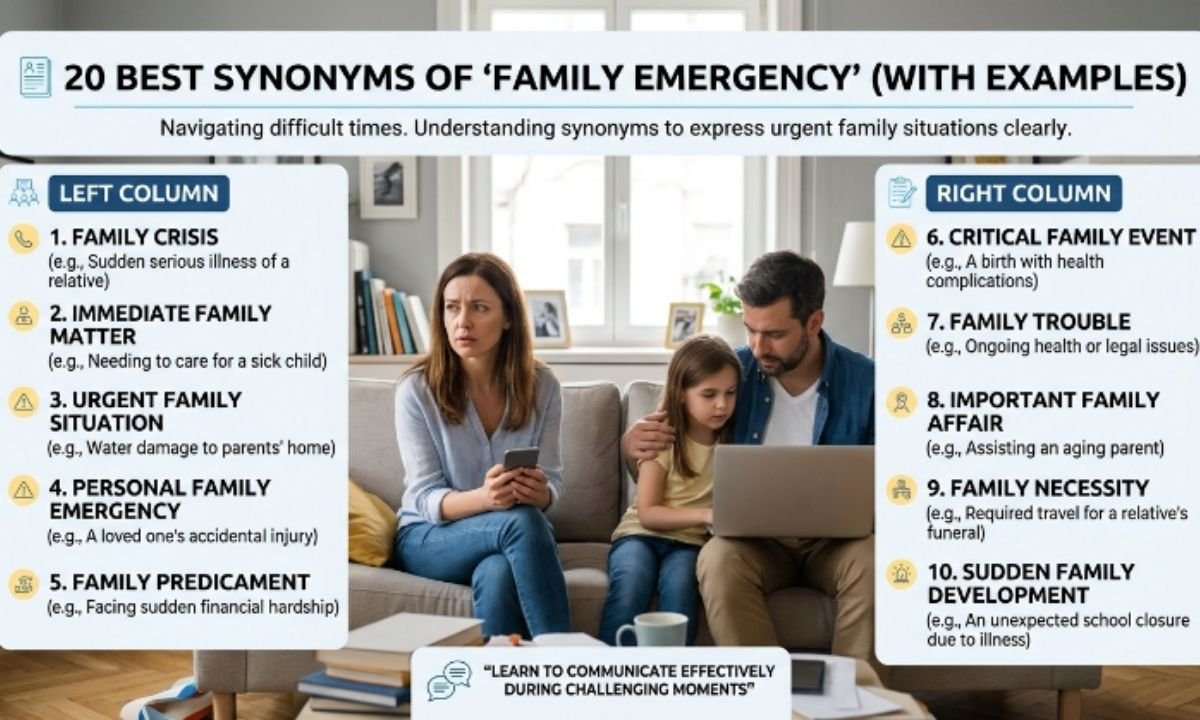

Explaining a sudden family situation to your boss, coworker, or friend can feel awkward. You want to be honest about needing time away, but you don’t always want to share every detail of what’s happening at home. That’s where having the right vocabulary comes in handy.
This guide breaks down 20 of the best alternatives to “family emergency,” explains when to use each one, and shows you how to sound professional, polite, and genuine whether you’re writing an email, sending a text, or speaking to your manager in person.
What Does “Family Emergency” Mean?
A family emergency is a sudden, serious, or unexpected event involving a family member that requires your immediate attention. It usually disrupts your normal schedule and demands quick action, whether that’s a medical issue, an accident, a death, or another urgent household matter.
The phrase typically signals three things:
- Urgency: something needs to be handled right away
- Personal priority: the situation outranks work or other obligations
- Limited detail: you’re not obligated to explain further
Because the term is broad, it covers everything from a parent’s hospital visit to a child’s school emergency. That flexibility is exactly why so many people search for alternative ways to phrase it sometimes “family emergency” feels too vague, too dramatic, or simply overused.
When to Use “Family Emergency”
You can reach for this phrase (or one of its alternatives) in situations like:
- Requesting sudden leave from work
- Explaining why you missed a meeting, deadline, or event
- Responding to a text or call that pulls you away unexpectedly
- Informing a teacher, coach, or event organizer that you need to leave early
- Declining an invitation without going into personal detail
The key is matching the phrase to the setting. A formal email calls for a different tone than a quick text to a friend, which is why this list separates alternatives by context later on.
Is It Professional or Polite to Say “Family Emergency”?
Yes , “family emergency” is widely accepted as both professional and polite. Most workplaces treat it as a legitimate, respected reason for sudden absence, and it doesn’t require you to disclose private details.
That said, it can sometimes feel:
- Too vague for HR documentation
- Overused, since so many people rely on it as a catch-all excuse
- Slightly impersonal in emotionally sensitive conversations
This is why many professionals rotate in synonyms depending on the audience something more specific like “family health issue” for a manager who needs planning details, or something softer like “personal matter” when you want to keep things private.
Another Word for Family Emergency
Below is a quick-reference list before we go deeper into each term, examples, and use cases.
Synonyms For “Family Emergency”
- Personal Emergency
- Family Matter
- Urgent Family Matter
- Private Family Matter
- Family Health Issue
- Medical Emergency at Home
- Sudden Family Situation
- Unexpected Family Issue
- Family Crisis
- Emergency at Home
- Family Obligation
- Critical Family Situation
- Immediate Family Concern
- Family-Related Emergency
- Urgent Personal Matter
Let’s look at each in more detail, including tone, best use case, and a real-world example sentence.
- Personal Emergency
Meaning: A broad term covering any urgent situation in your personal life, not limited to family.
Best Use: Workplace emails, HR forms, or when you’d rather not specify that it’s family-related.
Example: “I need to step away today due to a personal emergency.”
- Family Matter
Meaning: A general, low-intensity phrase for anything involving your family that needs attention.
Best Use: Casual conversations or situations that aren’t necessarily urgent.
Example: “I have a family matter to take care of this afternoon.”
- Urgent Family Matter
Meaning: Adds urgency to the general phrase above, signaling that immediate action is needed.
Best Use: Emails to supervisors or formal leave requests.
Example: “Due to an urgent family matter, I won’t be available for the rest of the day.”
- Private Family Matter
Meaning: Emphasizes confidentiality while still conveying seriousness.
Best Use: Situations where you want to discourage follow-up questions.
Example: “I’d prefer not to go into detail, but it’s a private family matter.”
- Family Health Issue
Meaning: Specifically points to a medical concern involving a family member.
Best Use: When the situation involves illness, injury, or a hospital visit.
Example: “I’ll be out this week because of a family health issue.”
- Medical Emergency at Home
Meaning: A direct way to say someone at home needs urgent medical attention.
Best Use: Explaining a sudden, serious departure from work or a social event.
Example: “I have to leave immediately — there’s a medical emergency at home.”
- Sudden Family Situation
Meaning: Highlights that the event was unplanned and requires quick response.
Best Use: When you need to explain last-minute changes to plans.
Example: “A sudden family situation came up, so I had to reschedule.”
- Unexpected Family Issue
Meaning: Similar to the above, but slightly softer and less alarming.
Best Use: Everyday conversations, casual emails, or texts.
Example: “Sorry for the short notice an unexpected family issue came up.”
- Family Crisis
Meaning: Conveys a high level of severity and emotional weight.
Best Use: Serious situations where extended time off may be needed.
Example: “I’m dealing with a family crisis and will need a few days away.”
- Emergency at Home
Meaning: A simple, direct phrase pointing to a household emergency.
Best Use: Quick explanations in person or over the phone.
Example: “I have to go there’s an emergency at home.”
- Family Obligation
Meaning: Suggests a responsibility rather than a crisis; less urgent-sounding.
Best Use: Planned but important family commitments, not necessarily emergencies.
Example: “I can’t make it to the event due to a family obligation.”
- Critical Family Situation
Meaning: Signals high severity, often used when things are serious but you’re avoiding specifics.
Best Use: Formal workplace communication requiring extended leave.
Example: “I’m facing a critical family situation and need to take the week off.”
- Immediate Family Concern
Meaning: Points specifically to a close relative parent, sibling, spouse, or child.
Best Use: HR paperwork or formal leave requests where relationship context matters.
Example: “I need leave to attend to an immediate family concern.”
- Family-Related Emergency
Meaning: A slightly more formal restatement of “family emergency” itself.
Best Use: Written communication, especially official emails.
Example: “I apologize for the late notice; this is a family-related emergency.”
- Urgent Personal Matter
Meaning: Keeps things vague while still communicating urgency.
Best Use: When you want maximum privacy with minimum explanation.
Example: “I have an urgent personal matter to attend to and will be offline today.”
Pros or Cons of Saying “Family Emergency”
| Pros | Cons |
| Widely understood and accepted | Can sound vague or overused |
| Doesn’t require sharing private details | May raise questions in formal HR settings |
| Signals urgency and priority | Some may perceive it as a generic excuse |
| Works across most professional settings | Doesn’t specify duration or severity |
| Evokes empathy and understanding | Repeated use can lose credibility over time |
Another Word for Family Emergency in Email
Emails call for slightly more formal phrasing than a text or in-person conversation. These options work well in written professional communication:
- Urgent Family Matter: “I’m writing to inform you of an urgent family matter that requires my immediate attention.”
- Family-Related Emergency: “Due to a family-related emergency, I will be unavailable for the remainder of the week.”
- Immediate Family Concern: “I need to request leave to address an immediate family concern.”
- Personal Emergency: “I regret to inform you that a personal emergency has come up.”
Keep email phrasing short, direct, and free of unnecessary detail. One or two sentences is usually enough.
Another Word for Family Emergency Slang
In casual or informal settings texting friends, group chats, or social media people often use shorter, more relaxed phrasing:
- “Fam stuff came up”
- “Something’s going down at home”
- “Family drama, gotta bounce”
- “House stuff, can’t make it”
- “Home situation, brb”
These work fine among close friends but should be avoided in professional or formal contexts.
Another Word for Family Emergency at Work
When speaking with a manager or coworker, aim for phrases that sound respectful and measured:
- Urgent Family Situation
- Family Health Issue
- Critical Family Situation
- Immediate Family Obligation
These phrases communicate seriousness without oversharing, which is exactly what most workplace conversations call for.
Another Word for Family Emergency Job
If you’re specifically requesting time off from your job through HR forms, leave requests, or formal applications the most accepted alternatives include:
- Compassionate Leave Situation
- Family Medical Leave Matter
- Urgent Family Obligation
- Family Care Emergency
Many companies even have specific policies (like FMLA in the U.S.) tied to these exact terms, so using them accurately can help your request get processed faster.
Trending Gen Z Terms for Family Emergencies

Younger generations tend to favor casual, low-key phrasing that softens the seriousness while still getting the point across:
- “Fam emergency, brb”
- “Something came up at the crib”
- “Home base needs me rn”
- “Gotta handle some house stuff”
- “Family sitch, can’t talk rn”
These terms work well in texts and DMs but aren’t appropriate for professional emails or formal requests.
Family Emergency Alternatives for Text and DMs
Texting calls for brevity. Here are some short, natural-sounding options:
- “Family thing came up”
- “Something’s up at home, gotta go”
- “Quick family situation, I’ll explain later”
- “Home emergency, calling you back soon”
These keep the tone light while still explaining your sudden unavailability.
Read More:What Does Zesty Mean in Slang? Explained Simply
Comparison Table of Top Alternatives
| Alternative Phrase | Urgency Level | Professional Use | Emotional Warmth |
| Personal Emergency | Medium | High | Medium |
| Family Matter | Low | Medium | High |
| Urgent Family Matter | High | High | Medium |
| Private Family Matter | Medium | High | Medium |
| Family Health Issue | Medium-High | High | High |
| Family Crisis | Very High | Medium | High |
| Emergency at Home | High | Medium | Medium |
| Family Obligation | Low | Medium | Medium |
| Critical Family Situation | Very High | High | Medium |
| Urgent Personal Matter | High | Very High | Low |
Comparison Table: Formal vs Casual Term Selection
| Setting | Recommended Phrase | Why It Works |
| Formal Email to Boss | Family-Related Emergency | Sounds professional and clear |
| HR Leave Request | Immediate Family Concern | Matches formal documentation tone |
| Text to a Friend | “Family thing came up” | Casual and easy to understand |
| Group Chat with Coworkers | Personal Emergency | Neutral and appropriate |
| Speaking to a Manager | Urgent Family Situation | Direct but respectful |
| DM to a Client | Urgent Personal Matter | Professional while staying private |
Conclusion
“Family emergency” is a perfectly acceptable phrase in almost any setting, but it isn’t the only option. Depending on who you’re talking to a boss, a coworker, a friend, or an HR representative a more specific or context-appropriate synonym can help you communicate more clearly while protecting your privacy.
Whether you choose something formal like “immediate family concern,” something urgent like “family crisis,” or something casual like “fam stuff came up,” the goal stays the same: explain your sudden absence with honesty and respect, without feeling pressured to share more than you’re comfortable with.
Frequently Asked Questions
What is another word for family emergency?
Common alternatives include “personal emergency,” “family matter,” “urgent family situation,” and “family crisis,” depending on the tone you need.
Is family emergency a valid excuse for work?
Yes, most employers accept “family emergency” as a legitimate reason for sudden absence without requiring detailed explanation.
What do Gen Z say instead of family emergency?
Younger people often use casual phrases like “fam emergency,” “home sitch,” or “family drama, gotta bounce.”
Can I use family matter instead of family emergency?
Yes, “family matter” works well when the situation is less urgent or you want a softer, more general phrase.
What is a formal synonym for family emergency?
“Family-related emergency,” “immediate family concern,” and “critical family situation” are all suitable formal alternatives.
How do I explain a family emergency in an email?
Keep it brief and professional, such as: “Due to an urgent family matter, I will be unavailable for the rest of the day.”
Why do people avoid repeating family emergency too often?
Overusing the same phrase can sound generic or insincere over time, so varying your wording helps maintain credibility and authenticity.
