
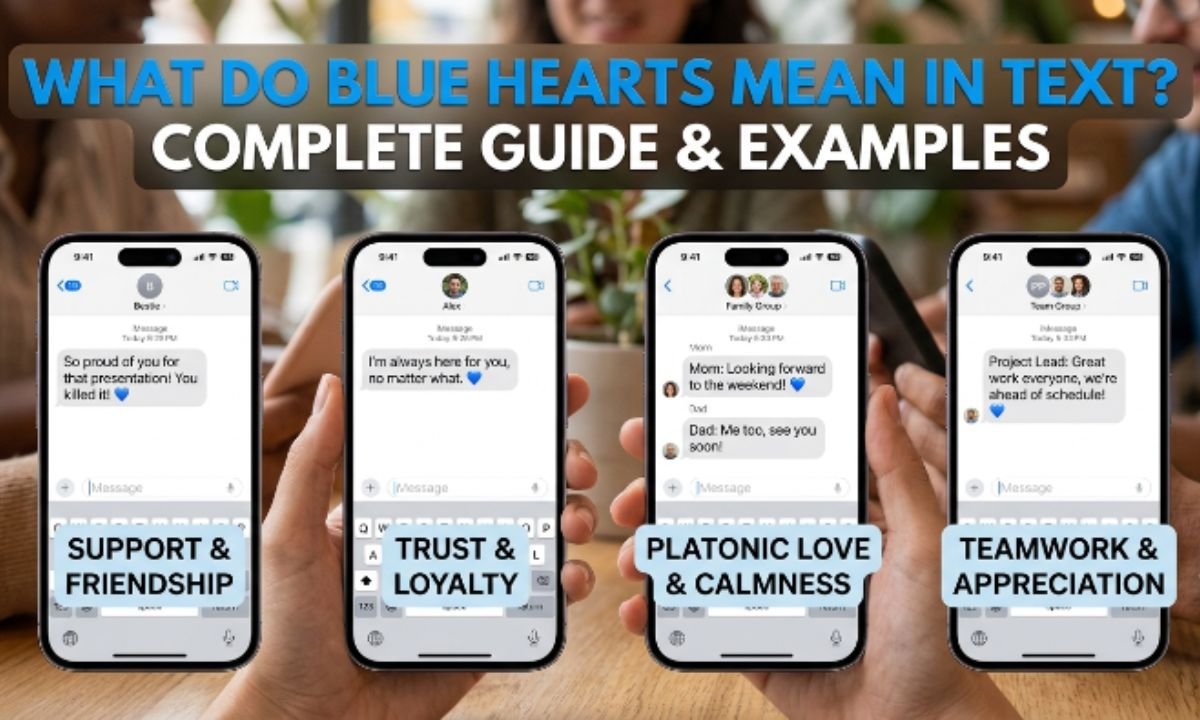

If someone just sent you a 💙 and you immediately opened a new tab to figure out what it means, you’re not alone. The blue heart emoji is one of the most texted — and most misread — symbols in modern messaging. Some people use it as a casual “love ya” to a friend. Others send it as a quiet, guarded way of saying “I like you” without the intensity of a red heart.
This guide breaks down exactly what a blue heart means in text, how the meaning shifts depending on who sends it, where it’s most commonly used, and how to tell if it’s romantic, platonic, or something in between.
What Do Blue Hearts Mean in Text?
At its core, the blue heart emoji (💙) represents trust, loyalty, calm, and stability. Blue is a “cool” color in emotional design — it doesn’t carry the heat of red or the urgency of pink. That’s exactly why people reach for it when they want to express real affection without turning up the romantic volume.
In everyday texting, a blue heart usually signals one of these things:
- Deep, steady friendship — the kind that doesn’t need grand gestures
- Quiet romantic interest — a soft way of testing the waters
- Support or comfort — sent after someone shares good or bad news
- Loyalty or admiration — often used with teammates, close coworkers, or long-time friends
- Fandom or identity — support for a sports team, brand, or cause that uses blue branding
Unlike the red heart, which almost always reads as “I love you” in a romantic sense, the blue heart is intentionally more ambiguous. That ambiguity is actually the point — it lets the sender express warmth while keeping some emotional distance.
Quick Meaning Snapshot
| Sender’s Intent | What Blue Heart Usually Means |
| Close friend | “You matter to me, platonically” |
| Someone you’re dating casually | “I like you, but I’m not rushing” |
| Family member | Warmth, support, connection |
| Sports fan / fandom | Team pride or fandom loyalty |
| Coworker or acquaintance | Friendly, safe, non-romantic |
| Long-term partner | Calm, stable, mature love |
What Do Blue Hearts Mean in Text From a Girl?
When a girl sends a blue heart, context is everything. Generally, it falls into one of three buckets:
- Platonic affection : she sees you as a close friend and the blue heart is her version of “I appreciate you.”
- Cautious romantic interest : she likes you but isn’t ready to escalate to a red heart. It’s a soft signal, not a bold declaration.
- Comfort or support : she’s responding to something emotional you shared, and blue feels calming rather than intense.
If she pairs the blue heart with consistent texting, inside jokes, or emojis like 😊 or 🥹, it likely leans romantic-but-cautious. If it shows up in a group chat or after a casual “good morning,” it’s almost certainly platonic.
What Do Blue Hearts Mean in Text From a Guy?
Guys tend to use the blue heart as a low-pressure emoji one that shows affection without feeling “too much.” A blue heart from a guy commonly means:
- He’s interested but being careful not to move too fast
- He considers you a close, trusted friend
- He’s more comfortable expressing loyalty than romance in writing
- He’s mirroring your energy — if you sent blue first, he’s matching it
Blue Heart Meaning From a Guy: Context Matters
| Situation | Likely Meaning |
| Sent after a deep conversation | Trust, emotional closeness |
| Sent randomly, no context | Casual friendliness |
| Sent instead of a red heart he usually avoids | Interest, but guarded |
| Sent consistently over weeks | Growing attachment |
| Sent once, no follow-up | Likely just polite or friendly |
A useful rule: guys who are emotionally reserved often use blue as a “safe” entry point before they ever send a red heart. If the frequency increases over time, that’s usually a sign the feelings are too.
What Do Blue Hearts Mean in Text From a Boy?
When it comes from a younger guy a teen or someone new to dating — the blue heart is often even less loaded. It’s frequently used simply because it looks nice, matches a profile theme, or is a habit picked up from friends. At this age, emoji use is often about social norms within a friend group rather than deep emotional signaling. Don’t over-analyze a blue heart from a teenage boy the same way you would from an adult in a defined relationship.
Blue Heart Meaning From a Woman
From an adult woman, particularly in a dating or early-relationship context, the blue heart often communicates emotional maturity and intentionality. Many women deliberately choose blue over red because:
- It avoids overwhelming a new connection with intensity
- It signals “I care” without implying commitment
- It keeps things light while still being affectionate
- It can double as a calming gesture after a stressful conversation
In long-term relationships, a woman sending a blue heart (instead of her usual red) can sometimes indicate she’s feeling more settled, calm, or reflective — not distant, just steady.
Where Are Blue Hearts Commonly Used?
Blue hearts show up far beyond one-on-one texting. Here’s where you’ll see them most:
- Group chats — as a quick, low-effort way to show appreciation
- Social media captions and comments — especially on friendship or throwback posts
- Sports and fandom posts — supporting teams with blue in their branding (e.g., soccer clubs, NFL teams)
- Brand marketing and promotions — companies use 💙 to signal trust and reliability
- Mental health and awareness campaigns — blue is tied to causes like autism awareness
- Patriotic or civic posts — often paired with other colors around national holidays
- Birthday and “thinking of you” messages — a gentler alternative to red
Common Contexts Table
| Context | Typical Purpose |
| Texting a friend | Platonic warmth |
| Texting a crush | Cautious romantic signal |
| Instagram/TikTok caption | Aesthetic or fandom expression |
| Brand social media post | Trust-building, call-to-action |
| Awareness campaign | Solidarity or support |
| Sports fan account | Team loyalty |
Examples of Blue Heart in Conversation
Seeing the emoji in real conversation makes the meaning click faster. Here are a few realistic examples:
Platonic Example
“Missed you at the game last night 💙” This reads as friendly warmth — no romantic undertone.
Cautious Romantic Example
“Had a really good time today 💙” Sent after a first or second date, this suggests genuine interest without overcommitting.
Supportive Example
“I know today was hard. I’m here for you 💙” Blue softens the emotional weight and offers comfort rather than intensity.
Fandom Example
“LFG 💙 #GameDay” Clearly about team spirit, not personal feelings.
Family Example
“Proud of you, always 💙” Common between parents, siblings, or close relatives.
When to Use and When Not to Use Blue Hearts
Blue hearts are versatile, but they’re not universally “safe” in every situation. Here’s a simple breakdown:
✅ Good Times to Use a Blue Heart
- Comforting a friend going through something difficult
- Showing appreciation in a group setting
- Supporting a sports team, cause, or brand
- Signaling early romantic interest without pressure
- Responding to good news from someone you care about platonically
❌ Times to Avoid a Blue Heart
- When someone has clearly expressed strong romantic feelings and expects a matching response (a blue heart may feel like a letdown compared to red)
- In professional or workplace messaging, unless the culture is very casual
- Right after a serious argument, where it may read as dismissive
- As a reply to a marriage proposal or major romantic milestone — it’s simply too understated
Other Meanings of Blue Hearts
Beyond texting and dating, blue hearts carry a few additional meanings worth knowing:
- Autism awareness : blue is widely associated with autism acceptance campaigns
- Police and first responder support : a “thin blue line” heart symbol is sometimes used to show solidarity with law enforcement
- Water and environmental causes : used to represent ocean conservation or clean water initiatives
- Depression and mental health awareness : some campaigns use blue to represent emotional struggle and the importance of support
- Corporate branding : many companies (tech, finance, healthcare) use blue tones because the color psychologically signals reliability
Similar Emojis or Alternatives
If you’re deciding between hearts, it helps to see how blue compares to its closest relatives.
| Emoji | Color | Common Meaning |
| ❤️ | Red | Passionate love, strong romance |
| 💙 | Blue | Trust, loyalty, calm affection |
| 🩵 | Light Blue | Gentle affection, softer than royal blue |
| 💚 | Green | Friendship, nature, jealousy (context-dependent) |
| 💛 | Yellow | Happiness, friendship moving toward romance |
| 🩷 | Pink | Sweetness, playful affection |
| 🖤 | Black | Edgy affection, sometimes grief or dark humor |
| 🤍 | White | Purity, sincerity, deep respect |
| 💜 | Purple | Compassion, fandom loyalty, sometimes romance |
| 🧡 | Orange | Warmth, enthusiasm, friendly energy |
If a blue heart feels too vague for what you want to say, a purple or pink heart often signals a stronger romantic lean, while green or yellow keep things firmly platonic.
Read More: What Does EMD Mean in Texting? Slang Explained (2026)
Why People Use Blue Hearts in Texting
There are a few psychological and social reasons the blue heart has become so popular:
- It’s emotionally safe. Blue doesn’t force a label on the relationship.
- It matches blue’s color psychology. Studies on color association consistently link blue with calm, trust, and dependability.
- It avoids miscommunication in group settings. Red hearts in a group chat can feel oddly intimate; blue does not.
- It’s popular in youth and online culture. Many younger users default to blue simply because it’s trendy in their friend circles.
- It works for both genders and all relationship types, which makes it a flexible “default” heart for many people.
Is the Blue Heart Romantic or Platonic?
This is the question most people are really asking — and the honest answer is: it depends entirely on context, not the emoji itself.
Use this quick checklist to judge intent:
- Frequency : Is it a one-time send or a regular habit?
- Consistency : Does the person ever escalate to red, pink, or purple hearts?
- Surrounding messages : Is the conversation flirty, supportive, or neutral?
- Relationship stage : Are you just friends, casually dating, or in a defined relationship?
- Tone of voice : Does the message feel warm-but-safe, or clearly affectionate?
A blue heart sent once in a casual group chat is almost never romantic. A blue heart sent consistently, privately, and alongside personal conversation carries much more emotional weight.
What Blue Hearts Signal About Digital Communication Habits
The rise of color-coded hearts reflects a bigger shift in how people communicate emotion online. Instead of writing out feelings, many people now rely on emoji as emotional shorthand — quick, low-risk signals that convey tone without requiring vulnerability.
The blue heart specifically reflects a broader trend toward cautious, low-pressure communication, especially among younger generations navigating dating and friendship in digital spaces. It allows people to:
- Express care without a formal declaration
- Test emotional waters before committing to bigger gestures
- Maintain plausible deniability (“It’s just a blue heart, not a red one”)
- Communicate across different relationship types using one flexible symbol
In short, the popularity of the blue heart says as much about modern texting culture — indirect, cautious, and context-driven — as it does about the emoji itself.
Why Blue Hearts Trend Heavily During Sports and Fandom Seasons
Search interest and usage of the blue heart emoji spike noticeably during major sporting events, especially for teams with blue branding — think baseball, soccer, and basketball franchises. During playoffs, championships, or rivalry games, fans flood social media with 💙 to show unified support.
This trend also extends to fandoms outside sports — music fan bases, gaming communities, and brand loyalists frequently adopt a specific heart color, and blue is one of the most common choices because so many logos and team colors are blue. During these seasons, the blue heart temporarily shifts from a personal, relational symbol to a collective identity marker, showing belonging to a group rather than affection for an individual.
Conclusion
The blue heart emoji is one of the most flexible symbols in modern texting — and that flexibility is exactly why it causes so much second-guessing. On its own, 💙 leans toward trust, loyalty, and calm affection rather than intense romance. But the real meaning always comes from context: who sent it, how often, and what the rest of the conversation looks like.
Whether it’s a friend showing appreciation, a crush testing the waters, or a fan cheering for their team, the blue heart lets people express warmth without overcommitting. If you’re trying to decode one sent your way, look past the emoji itself and pay attention to the pattern of the relationship — that’s where the real answer lives.
Frequently Asked Questions
Does a blue heart mean someone likes me romantically?
It can, but not always. A blue heart is more often platonic or cautiously affectionate — look at frequency and context before assuming romantic interest.
Is a blue heart better or worse than a red heart?
Neither is “better” — they’re different. Red signals strong romance, while blue signals trust, calm, and lower-pressure affection.
Why do guys use blue hearts instead of red hearts?
Many guys use blue because it feels safer and less intense, allowing them to show interest without fully committing emotionally in writing.
Can a blue heart be used between just friends?
Yes, absolutely. The blue heart is one of the most common emojis used purely for platonic friendship and support.
What does it mean if someone switches from blue to red hearts?
This usually signals growing feelings or increased comfort expressing romantic interest more openly.
