

You’re scrolling through a conversation, everything feels normal, and then it lands: “wtv.”
No punctuation. No emoji. Just three lowercase letters sitting there like a closed door.
Your brain immediately starts running diagnostics. Did I say something wrong? Are they mad? Is this just how they text?
Here’s the honest answer: WTV means “whatever.” That part is simple. What’s not simple is figuring out what “whatever” actually means coming from this person, in this conversation, at this moment. The letters never change. The emotional weight behind them changes constantly.
This guide breaks down everything WTV can mean — by sender, by platform, by tone — so you’re never left guessing again.
You Got “WTV” and Now You’re Wondering If You Messed Up
Let’s start where most people actually start: mid-panic, staring at a single text.
You asked a question. You suggested a plan. You apologized for something. And the reply that came back was just “wtv.” No context clues, no follow-up, nothing to work with.
The instinct is to assume the worst — that you upset someone and they’re shutting the conversation down. Sometimes that’s exactly right. But just as often, WTV is someone typing the fastest possible version of “I’m easy either way” while multitasking, distracted, or simply not big on typing full sentences.
Before you spiral, remember this: a three-letter word carries almost no tone on its own. The panic usually comes from the silence around it, not the word itself.
Breaking Down What WTV Really Sounds Like
At its core, WTV is a shortened form of “whatever,” used the same way people have used “whatevs” or a dismissive shrug for years. It’s built for speed texting culture rewards short replies, and WTV lets someone respond without typing out a full word or forming a complete sentence.
But “whatever” itself is a flexible word in English. Say it out loud in different tones and you’ll notice it can sound:
- Agreeable : “Whatever works for you.”
- Indifferent :”Whatever, I don’t really mind.”
- Annoyed : “Whatever. Forget it.”
- Dismissive :”Whatever, I’m not discussing this anymore.”
WTV inherits all four of those tones. The letters don’t tell you which one you’re getting — the surrounding conversation does.
What Does WTV Mean in Text From a Girl
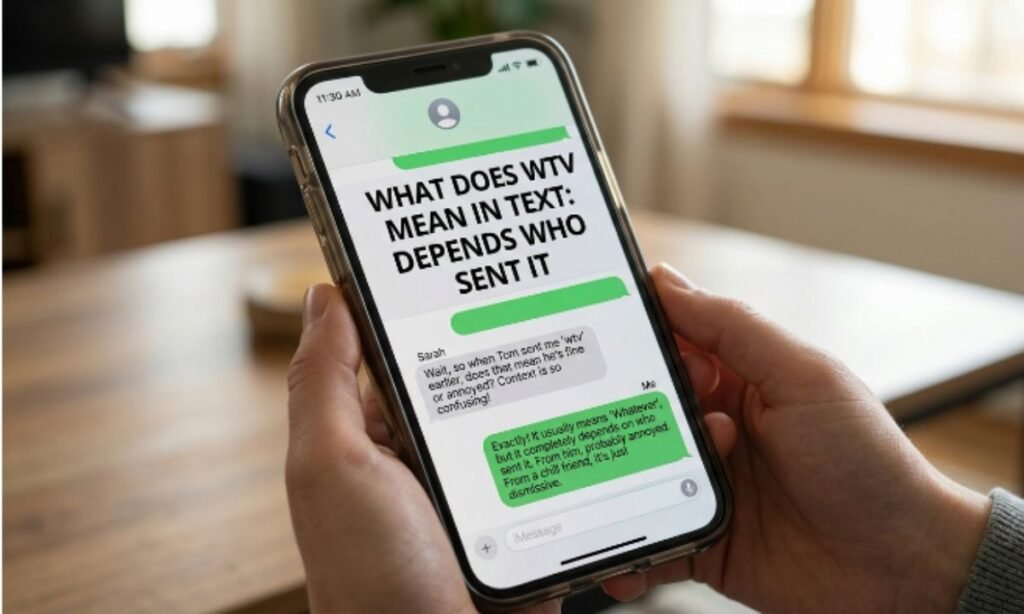
There’s no universal rulebook that applies to every girl who sends WTV, but patterns do show up in how it’s commonly used.
- In a lighthearted exchange: WTV often just means “I genuinely don’t have a preference.” If she’s replying to “pizza or sushi?” with “wtv,” she’s not annoyed she’s just easygoing about the decision.
- After a disagreement or awkward moment: WTV can be a way of ending a conversation without escalating it. It’s less “I’m furious” and more “I don’t want to keep talking about this right now.”
- With a period or in all caps (“WTV.” or “Wtv.”) : this shift in punctuation often signals more finality or frustration than a lowercase, no-punctuation “wtv.”
The biggest factor isn’t gender it’s the relationship and the conversation history. A close friend who always types short, blunt replies isn’t being cold. Someone who normally sends paragraphs and suddenly drops to “wtv” is telling you something changed.
What Does WTV Mean on Snapchat
Snapchat conversations move fast, and WTV shows up there just as often as in regular texting sometimes more, because Snapchat’s casual, disappearing nature encourages short replies over full sentences.
On Snapchat, WTV tends to show up in a few specific situations:
- Quick chat replies between snaps, where typing a full response feels unnecessary.
- Group chats, where someone is replying fast just to keep the conversation moving.
- Story replies, where WTV can mean “cool, no strong opinion” about whatever was posted.
Because Snapchat conversations are often more visual and reactive than word-heavy, WTV there tends to lean casual rather than emotionally loaded though the same context rules from regular texting still apply if it shows up during a tense exchange.
What Does WTV Mean in Text From a Guy
Again, this isn’t really about gender — it’s about texting habits, which do tend to differ in patterns (not absolutes) between people who text minimally versus those who text expressively.
Guys who default to short, low-effort texting in general are more likely to use WTV as a neutral filler word — not a loaded one. If someone’s usual texting style is one-word answers, “wtv” fits right into that pattern and probably isn’t meant to sting.
The signal worth watching for is a change in pattern:
| Normal texting style | Suddenly sends “wtv” | Likely meaning |
| Usually replies with full sentences | Switches to just “wtv” | Something’s off or they’re distracted/annoyed |
| Always texts short and blunt | Sends “wtv” | Just their normal communication style |
| Was actively engaged in the conversation | Goes quiet, then “wtv” | Possible frustration or disinterest in the topic |
| Texting fast, back-to-back replies | “wtv” mixed in casually | Likely just moving quickly, no deeper meaning |
What Does WTB Mean in Text
WTV often gets confused with a similar-looking abbreviation: WTB. They look alike but mean completely different things.
WTB stands for “Want To Buy” (sometimes “Willing to Buy” or “Waiting to Buy”). It’s common in marketplace posts, gaming communities, and trading groups basically anywhere people are buying, selling, or trading items.
Examples of WTB in use:
- “WTB PS5 controller, must be in good condition.”
- “WTB Rolex Daytona, DM if you have one.”
- In gaming trade chats: “WTB legendary sword, offering gold.”
It’s almost always paired with related terms:
- WTS: Want To Sell
- WTT : Want To Trade
So while WTV is an emotional/tonal word about indifference, WTB is a transactional word about buying. Mixing them up in a sentence would completely change the meaning “wtv that jacket” (I don’t care about that jacket) versus “wtb that jacket” (I want to buy that jacket) are opposite intents.
Where You’ll Actually See WTV Pop Up
WTV isn’t limited to one app or one type of conversation. You’ll typically run into it in:
- Text messages (SMS/iMessage) :usually in casual, fast-paced exchanges
- Snapchat chats : often replying to snaps or stories
- Instagram DMs : especially in comment replies or quick DM back-and-forth
- Group chats : where people type fast to keep up with the conversation
- Gaming chat : (Discord, in-game chat) :often about decisions like “which map” or “who goes first”
- Comment sections :as a quick, low-effort reaction to a post or opinion
The common thread across all of these: WTV thrives in low-stakes, high-speed communication where a full sentence feels like overkill.
The Same Three Letters Can Mean Totally Different Things
This is really the heart of the whole topic. WTV isn’t a word with one fixed meaning it’s a word whose meaning bends around context. Here’s a side-by-side look at how identical letters shift entirely based on what surrounds them.
| Message | Likely Meaning |
| “wtv, I’m cool with pizza 🍕” | Genuinely relaxed, no preference |
| “wtv you decide” | Handing over the choice, easygoing |
| “wtv.” (period, no emoji) | Mild frustration or wanting to end the topic |
| “WTV” (all caps, standalone) | Likely annoyed or dismissive |
| “lol wtv” | Playful, not serious |
| “wtv 🙄” | Sarcastic, annoyed, or over the conversation |
| “wtv happens, happens” | Calm acceptance, low stakes |
Notice the pattern: capitalization, punctuation, emojis, and surrounding words do almost all the emotional heavy lifting. The letters themselves are just the neutral core.
Times When Typing WTV Will Backfire on You
Read More: What Does OOO Mean in Text? Explained for 2026
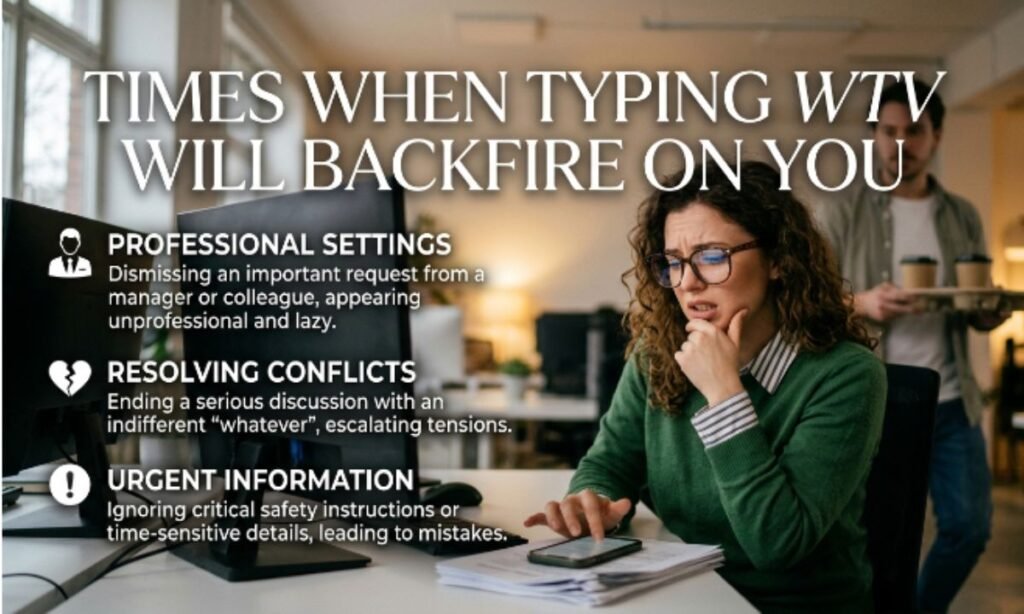
Even though WTV feels harmless to type, there are moments where it can land badly or make you look unprofessional.
- In an argument :WTV can escalate tension instead of calming it. It often reads as “I’m done talking,” which can feel dismissive to the other person.
- When someone needs real input :If a friend asks for genuine advice or is venting about something serious, replying “wtv” can come across as careless, even if you didn’t mean it that way.
- In professional or academic messages : WTV is internet slang through and through. Using it in an email to a boss, teacher, or client instantly reads as too casual.
- When the other person is emotionally invested : If someone put thought into a message and you reply with three letters, it can feel like their effort wasn’t matched.
- With someone new : Early in a friendship or relationship, WTV can be misread more easily since there’s no established texting pattern to reference yet.
Here’s What WTV Looks Like in Actual Conversations
Seeing WTV in real exchanges makes the tone shifts easier to spot.
Example 1 : Casual and relaxed
Person A: Movie night, your pick or mine?
Person B: wtv, I’m down for either
Example 2 : Slightly annoyed
Person A: Can we talk about what happened earlier?
Person B: wtv, it’s fine
Example 3 : Ending an argument
Person A: I really think you overreacted.
Person B: wtv
Example 4 : Genuinely indifferent
Person A: Should we grab coffee or just meet at the park?
Person B: wtv works, I’m flexible
Reading these side by side, the word is identical every time — but the emotional temperature is clearly different in each one.
That “From a Girl vs From a Guy” Thing Everyone Finds Out
A lot of people search specifically for gendered breakdowns of texting slang, hoping there’s a secret decoder ring. The honest truth people eventually find out: texting style is a much bigger predictor of meaning than gender is.
What actually determines the meaning behind someone’s WTV:
- How much they normally type
- How the conversation was going right before it
- Whether punctuation or emojis were added
- The history and comfort level between the two of you
- Whether it’s a repeat pattern or a one-off
Two people of any gender who are naturally short texters will use WTV the exact same way — as filler, not as a red flag. The “girl vs guy” framing is popular because it’s a common search pattern, but the real answer lives in communication habits, not gender norms.
Different Apps, Slightly Different Vibes for WTV
While the core meaning stays the same everywhere, the general “vibe” of WTV can shift slightly depending on the platform.
| Platform | Typical Vibe |
| Texting (SMS/iMessage) | Can range from casual to serious, since it’s often 1-on-1 |
| Snapchat | Usually light and quick, matches the app’s fast pace |
| Instagram DMs | Casual, sometimes flirty or joking depending on context |
| Group chats | Very low-stakes, often just keeping the chat moving |
| Gaming chat | Practical and decision-based (“wtv map, don’t care”) |
Myths People Believe About WTV
A few misconceptions come up again and again around this word:
- Myth: WTV always means someone is upset.
Not true : it’s frequently used as a neutral, easygoing response with zero negative charge. - Myth: Only teenagers use WTV.
While it’s popular with younger texters, plenty of adults use it too, especially in casual friendships and family group chats. - Myth: WTV and “whatever” always mean the exact same thing in tone.
Not quite because WTV is so short, it can actually feel less intense than typing out the full word “whatever,” which sometimes reads more deliberately dismissive. - Myth: There’s one universal meaning everyone agrees on.
As shown throughout this article, meaning shifts heavily based on context, punctuation, and relationship.
Smart Ways to Reply When You Get Hit With WTV
If you’re unsure how to respond after receiving a WTV that feels ambiguous, here are some solid options:
- Ask directly, lightly: “wtv as in you’re annoyed, or wtv as in you don’t care? 😅”
- Give them an easy out: “All good, no pressure either way!”
- Match their energy if it seems casual: “lol fair, wtv works for me too”
- Address it if it feels like tension: “Hey, did I say something wrong?”
- Don’t overreact immediately : wait for one more message before assuming the worst.
The safest move is almost always to ask rather than assume, especially if the conversation actually matters to you.
WTV in Gen Z Texting Culture
WTV fits into a much bigger pattern in modern digital communication: short, low-effort replies replacing full sentences. It sits alongside abbreviations like “idc,” “ngl,” and “fr” as part of a texting style built around speed over formality.
For younger texters especially, dropping vowels and shortening words isn’t laziness it’s just the accepted shorthand of the medium. Full sentences can even read as more formal or serious than intended, which is part of why short replies like WTV have become the default in casual digital spaces.
WTV Compared to Similar Texting Abbreviations
| Abbreviation | Meaning | Tone |
| WTV | Whatever | Neutral to dismissive, depends on context |
| IDC | I don’t care | Usually blunter and more direct than WTV |
| IDK | I don’t know | Uncertainty, not indifference |
| NVM | Never mind | Dropping the topic entirely |
| WTB | Want to buy | Transactional, unrelated to emotion |
| FR | For real | Emphasis/agreement |
WTV tends to sit in a softer middle ground compared to IDC “whatever” can carry an easygoing, flexible tone, while “I don’t care” often feels more final and blunt.
Conclusion
WTV will always technically mean “whatever” that part never changes. But whether it means “I’m totally fine either way” or “I don’t want to talk about this anymore” depends entirely on who sent it, how they normally text, and what was happening in the conversation right before it landed in your inbox.
Instead of overanalyzing three letters in isolation, look at the bigger picture: punctuation, timing, emojis, and the sender’s usual texting habits. Most of the time, WTV is just fast, casual shorthand not a hidden message you need to decode. And if you’re ever genuinely unsure, there’s nothing wrong with just asking.
Frequently Asked Questions
What does WTV mean in a text message?
WTV is short for “whatever,” typically used to express indifference, agreement, or a casual dismissal of something being discussed.
Is WTV always a rude reply?
No. WTV is often just an easygoing, low-effort response its tone depends heavily on context, punctuation, and the relationship between texters.
What does WTV mean on Snapchat specifically?
On Snapchat, WTV usually keeps its standard “whatever” meaning, often used casually in quick chat replies or story responses.
How do I know if WTV means someone is mad?
Look for added punctuation, capital letters, or a sudden shift from their usual longer texting style these often signal frustration rather than neutrality.
Is WTV the same as WTB?
No. WTV means “whatever,” while WTB means “Want to Buy” and is used in buying, selling, or trading contexts.
Should I reply if someone sends just WTV?
Yes, especially if the conversation matters to you a light follow-up question can clarify their tone without escalating anything.
Do guys and girls use WTV differently?
Not significantly. Texting style (short vs. expressive) is a much stronger predictor of meaning than gender is.
