

If you’ve spent any time on TikTok, in a group chat, or in your kid’s Snapchat messages, you’ve probably run into the word “cap” being tossed around like confetti. Someone claims they ran a 4-minute mile, and the reply comes back instantly: “That’s cap.” Someone else backs up a wild story with “no cap,” and suddenly you’re left wondering what any of this has to do with hats.
You’re not imagining things “cap” really has become one of the most widely used slang terms of the last decade. This guide breaks down exactly what it means, where it came from, how it’s used across different platforms, and why it’s stuck around long enough to become a permanent fixture in internet vocabulary.
What Does Cap Mean?
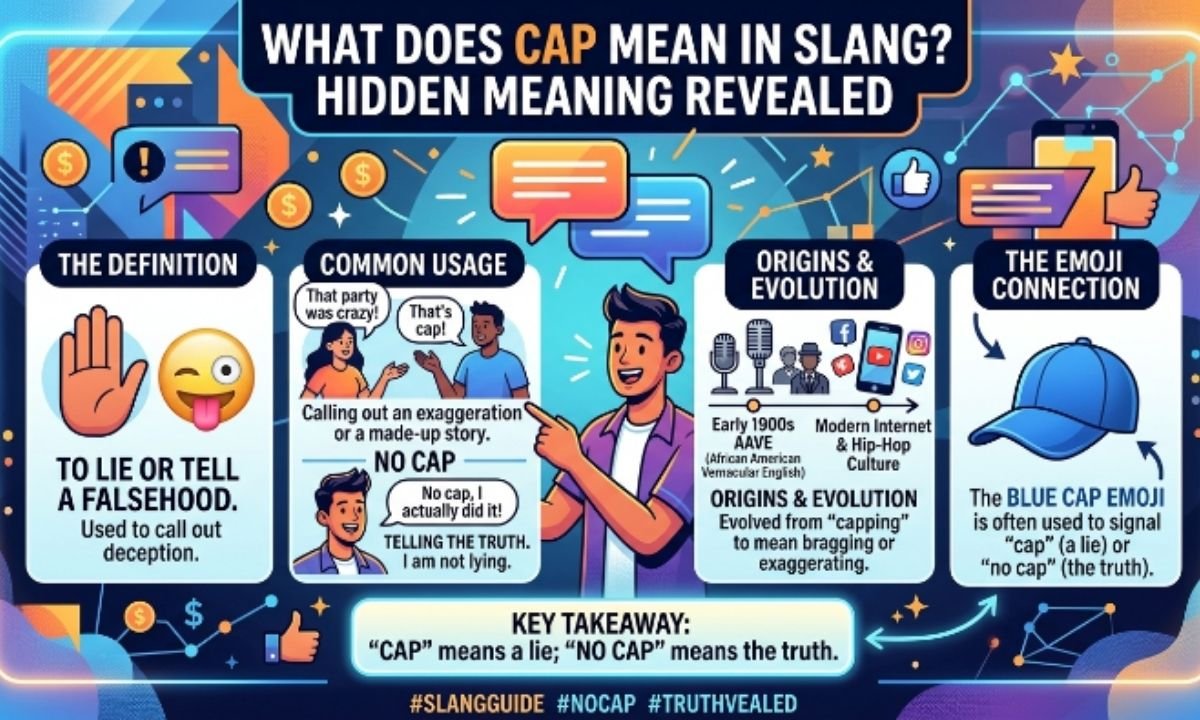
In plain English, cap means a lie, an exaggeration, or something that simply isn’t true. In slang, cap means a lie, exaggeration, or just something that’s not true. If a friend tells you an unbelievable story and you don’t buy it, you might respond with “cap” or “that’s cap” to call it out.
It also works as a verb. In modern-day usage, cap is often used as a verb or an adjective to describe something as fake or dishonest for example, someone might say “he’s capping” to mean “he’s lying,” or “that story is cap” to mean “that story is fake.”
And on the flip side, there’s its more famous partner: “no cap,” which flips the meaning entirely and means someone is being 100% honest.
Origin and History of “Cap”
The slang meaning of “cap” didn’t appear out of nowhere overnight it has real linguistic roots.
The slang meaning of cap originated in African American Vernacular English (AAVE) and has been used in hip hop and street culture for decades. Some link its origin to the phrase “high cap,” which was used in Southern Black communities to describe someone who boasts or brags excessively; over time, the term evolved and “capping” became synonymous with lying or exaggerating.
Interestingly, the word has had other slang meanings in the past too. A generation ago, “cap” was slang for shooting someone, but in recent years it’s used to signify lying or bragging instead. That’s a good reminder that slang words don’t stay frozen in time they shift meaning as new generations adopt them.
The word really exploded into mainstream awareness through music. Artists like Future and Young Thug helped popularize the phrase in the 2010s, and the widespread use of “cap” and “no cap” can largely be attributed to hip-hop artists and social media influencers, with rappers like Young Thug and Future popularizing the phrase in their music, particularly in the song “No Cap” (2017). From there, it spread rapidly into everyday teen vocabulary and eventually into mainstream pop culture.
What Does Cap Mean in Slang?
At its core, calling something “cap” is a way of flagging dishonesty in casual conversation. It’s short, punchy, and doesn’t require an explanation everyone in the conversation instantly understands what you mean.
Read More:What Does PPL Mean in Text? The Casual Shortcut Acronym
Here’s a simple breakdown of the core slang meanings:
| Term | Meaning | Example |
| Cap | A lie or exaggeration | “That’s cap.” |
| No cap | Telling the truth, no lie | “This pizza is amazing, no cap.” |
| Capping | The act of lying | “Stop capping, I know the truth.” |
| Capper | Someone who lies often | “He’s such a capper.” |
It’s worth noting that “cap” doesn’t just describe outright lies it’s often used more loosely to call out exaggeration, bragging, or claims that sound too good to be true.
What Does Cap Mean in Urban Dictionary?
Search “cap” on Urban Dictionary and you’ll find definitions that line up closely with everyday usage: to cap means to lie, exaggerate, or brag about something that isn’t accurate. To say cap to someone is to say they are exaggerating or stretching the truth, and it’s a word said when you think what someone is saying is not true — most often used in the expression “that’s cap,” meaning you think what someone just said is definitely not true.
Crowdsourced slang dictionaries like this are useful because they capture real, everyday usage as it evolves — often faster than traditional dictionaries can keep up with.
Cap meaning slang origin
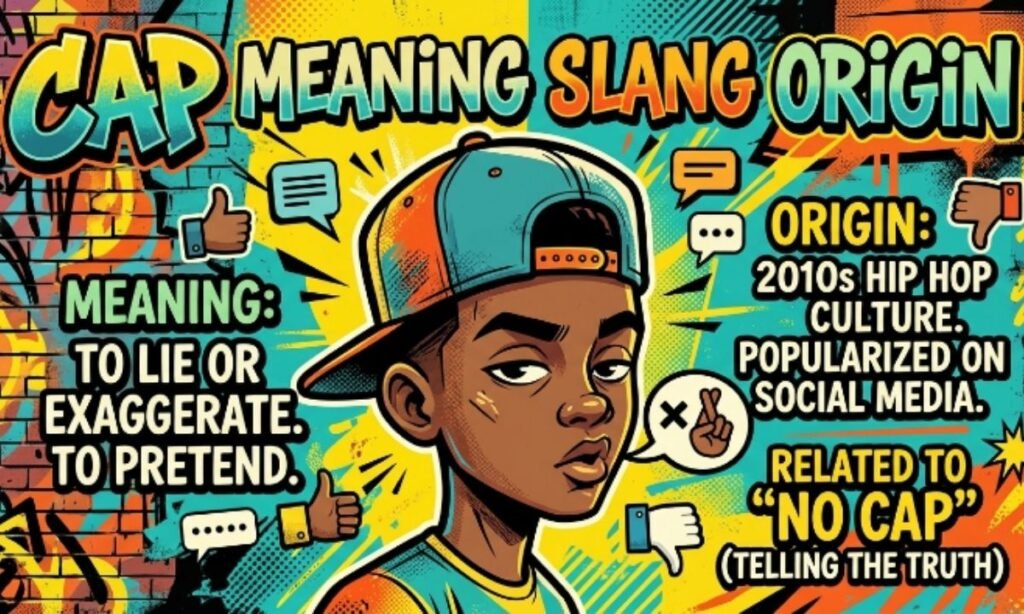
To recap the origin story in one place: the term traces back to AAVE and hip-hop culture, likely evolving from “high-capping” (bragging), before being popularized in mainstream music and social media during the 2010s. It’s a textbook example of slang that started in a specific cultural context and gradually became part of everyday, cross-generational vocabulary.
What Does “No Cap” Mean in Slang?
“No cap” is essentially the opposite of “cap.” “No cap” means “no lie.” It’s used to add emphasis and signal that what someone is saying is 100% true almost like adding an exclamation point to a bold claim or promise.
“No cap” is used to indicate that someone is being truthful or sincere for example, “No cap, that’s the best burger I’ve ever had” means “I’m being serious, that’s the best burger I’ve ever had.”
People typically use “no cap” in two ways:
- To back up a genuinely surprising or bold statement (“I finished the whole project in one night, no cap.”)
- To pre-empt disbelief before someone even has the chance to doubt you (“No cap, I saw a celebrity at the grocery store today.”)
Why Does Cap Mean Lie?
This is one of the most common questions people have, and the honest answer is: nobody has one single confirmed origin story. What’s generally agreed upon is that “cap” grew out of the idea of “capping” someone’s story essentially putting a lid or a limit on the truth by exaggerating past it, similar to “topping” someone’s claim with something even bigger and less believable.
Over time, “capping” shifted from meaning “bragging” to meaning “lying” outright, and the shorthand “cap” stuck as the go-to word for calling something out as false.
Cap Meaning in Gaming and Twitch Chats
Gamers and streamers have their own flavor of this slang, closely tied to Twitch culture.
On Twitch, you’ll often see the emote-based term “Kapp” used in a very similar way to “cap.” Kapp is commonly used when a streamer makes an obviously false or exaggerated claim, when someone in chat is being sarcastic, when a streamer pretends they didn’t make a mistake, during moments of playful deception, or as a response to unlikely promises or predictions and it’s particularly popular in competitive gaming streams where players make excuses about their performance.
Kapp itself is a spin-off of the older and more iconic Kappa emote. Kappa is a Twitch emote generally used to relay sarcasm or as an “eye-roll” response to something a streamer says or does, and people will type or say the word “Kappa” to convey that same meaning. Kapp is described on Urban Dictionary as an adaptation of the popular Kappa emote essentially “the right half of Kappa” used the same way, to express sarcasm.
In gaming lobbies and streams, you’ll frequently hear phrases like:
- “He said he’s never lost a 1v1 total cap.”
- “No cap, that clutch was insane.”
- “Kapp” typed in chat right after someone makes an unbelievable claim.
Whether it’s “cap,” “no cap,” or “Kapp,” the underlying function is the same: calling out (or defending against) exaggeration in real time.
How “Cap” Is Used on Different Platforms
“Cap” doesn’t look exactly the same everywhere it shows up. Here’s a quick comparison of how it tends to appear across different corners of the internet:
| Platform | Typical Usage |
| TikTok | Used in comments and captions to call out exaggerated claims or challenge trends |
| Common in comment sections, often paired with the 🧢 emoji | |
| Snapchat | Frequently used in casual texting between friends |
| Twitch | Appears as “cap,” “no cap,” or the emote-based “Kapp” |
| Twitter/X | Used to call out misleading posts or bold claims |
| Discord | Common in gaming and community servers during conversations or debates |
You’ve probably seen cap slang all over social media platforms like TikTok, Snapchat, and Instagram, and people even use the 🧢 (billed cap) emoji to represent the word visually.
Cap in Texting vs. Real Life
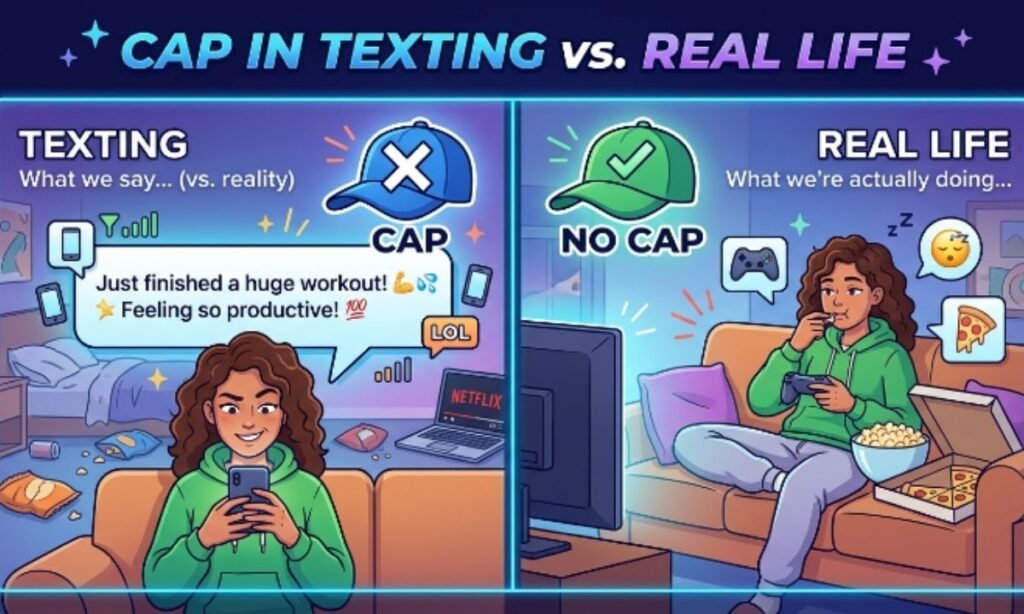
There’s a subtle difference in how “cap” shows up in text versus spoken conversation.
In texting:
- Often shortened or paired with emojis (🧢 for “cap,” sometimes 🚫🧢 for “no cap”)
- Used quickly and casually, often as a one-word reply
- Easy to search chat history for patterns of use
In real life (spoken conversation):
- Usually said with a specific tone often playful, teasing, or half-joking
- Frequently paired with body language, like a skeptical look or laugh
- Tends to be used more sparingly than in text, where it’s an easy one-word reaction
In both settings, though, the core meaning stays consistent it’s about calling out or confirming truthfulness in a fast, casual way.
Examples of “Cap” in Sentences
Seeing the word in context makes it much easier to understand. Here are some real-style examples:
- “He said he benches 300 pounds that’s cap.”
- “I finished the entire assignment in an hour, no cap.”
- “Stop capping, I literally saw you eat the last slice.”
- “She claims she’s met the whole cast, but I think she’s capping.”
- “This is the best coffee I’ve had all year, no cap.”
- “Don’t even try to tell me you won the game last night. I was there, no cap.”
- “I don’t think you’re capping, but I need to hear the whole story to be sure.”
Variations and Related Slang
“Cap” has spawned a handful of related terms and word forms that are just as common:
- Capper: someone who lies frequently
- Capping: the ongoing act of lying or exaggerating
- No cap: emphasizing honesty
- 🧢 emoji: visual shorthand for “cap”
- Kapp / Kappa: the Twitch-specific version tied to sarcasm and disbelief
It also sits alongside other truth-related slang like “fr fr” (for real, for real) and “deadass,” which serve a similar emphatic function to “no cap.”
Cap Meaning Used by Brands and Influencers
Marketers haven’t ignored this trend. Beyond social media, “cap” has infiltrated mainstream pop culture, with celebrities, athletes, and brands adopting the term in marketing campaigns, interviews, and public statements.
For brands trying to connect with younger audiences, using the term effectively comes down to a few things:
- Authenticity first: Using “no cap” to emphasize genuine product features or honest reviews works far better than forcing slang into copy that doesn’t fit the brand voice.
- Reading the room: Recognizing when followers use “cap” in comments to address concerns authentically helps brands respond appropriately rather than awkwardly.
- Respecting the roots: Acknowledging and respecting the term’s origins in AAVE while using it appropriately matters, since overusing or misusing slang from a specific cultural context can come across as forced or disrespectful.
Is “Cap” Safe for Kids?
Generally, yes. The slang term “cap” is harmless, and most slang dictionaries agree it’s low-risk. This term is generally not offensive, but context matters, and appropriate usage should be based on setting and audience.
That said, there are a couple of things worth keeping in mind as a parent or guardian:
- The word itself is harmless, but it’s worth watching for the context in which it’s used is your child being playful, or is it tied to something more concerning in a conversation?
- Other teenage slang terms could indicate risky behaviors or communication with potentially dangerous people, even if “cap” itself isn’t one of them.
- Slang is a great conversation starter asking your kid what a term means can open the door to bigger conversations about their online world.
When to Use (and Avoid) “Cap”
Like most slang, “cap” fits some settings much better than others.
Good times to use it:
- Casual texting with friends
- Comment sections on social media
- Gaming chats or Discord servers
- Light, playful conversations
Times to avoid it:
- Professional emails or workplace communication
- Academic writing or formal essays
- Conversations with people unfamiliar with the term, where it may cause confusion
- Any formal or first-impression setting, like a job interview
A simple rule of thumb: if you wouldn’t use “lol” or an emoji in that context, you probably shouldn’t use “cap” either.
Conclusion
“Cap” has come a long way from its roots in AAVE and hip-hop culture to become one of the most recognizable slang terms across texting, social media, and gaming spaces. At its core, it’s simple: cap means a lie or exaggeration, and no cap means the truth. Once you understand that one flip, the rest of the slang built around it capper, capping, Kapp, the emoji all falls into place naturally.
Whether you’re a parent trying to decode your teen’s texts, a brand trying to sound authentic online, or just someone who wants to keep up with internet culture, knowing what “cap” means (and how to use it appropriately) makes those conversations a whole lot easier to follow. No cap.
Frequently Asked Questions
What does cap mean in a text message?
In a text message, “cap” means the person thinks a statement is a lie or an exaggeration it’s a quick way of calling out something as untrue.
Does no cap always mean telling the truth?
Yes, “no cap” is used to emphasize honesty, signaling that the speaker is being sincere and not lying.
Is cap slang used more by teenagers than adults?
It’s most common among teens and young adults, though it has spread widely enough that many adults use it casually too, especially online.
Where did the term cap originally come from?
It originated in African American Vernacular English (AAVE) and hip-hop culture, likely evolving from the phrase “high-capping,” meaning excessive bragging.
Can cap be used as a verb?
Yes, “cap” can be used as a verb, as in “he’s capping,” which means “he’s lying.”
Is it okay for kids to use the word cap?
Generally yes it’s considered a harmless slang term, though context and setting still matter.
Is cap related to the gaming term kapp?
Yes, “Kapp” is a Twitch-specific variation tied to the Kappa emote, used similarly to call out sarcasm or disbelief, much like “cap” is used elsewhere.
